Natural Sandstone vs Sandstone-Look Porcelain Pavers
Sandstone-look porcelain copies the look of stone in a low-absorption tile. How it compares with natural sandstone for grip, chips, upkeep and detailing.
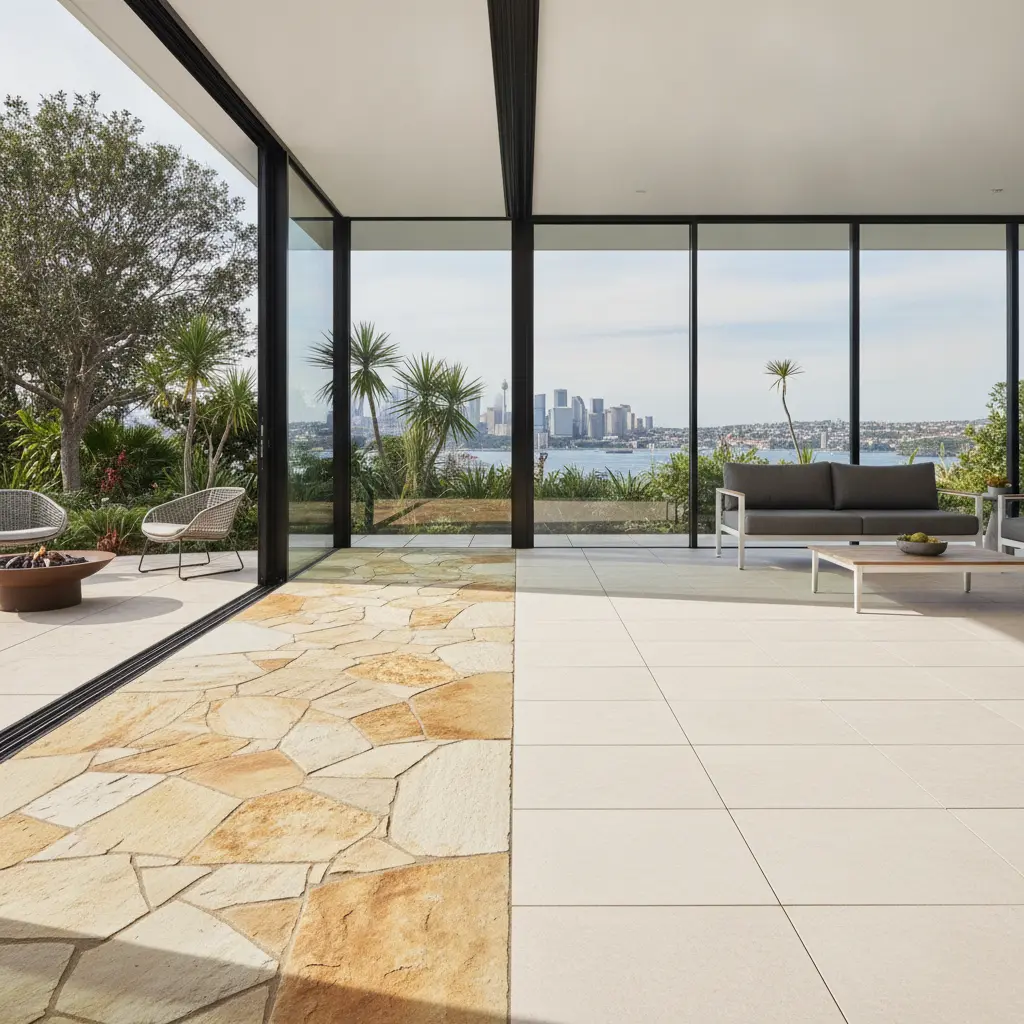
The short answer
Choose sandstone-look porcelain if you want a uniform, very low-absorption surface that does not need sealing, identical sizes for a tight modern layout, and you accept a printed pattern that repeats and chips that can show a different body colour. Choose natural sandstone if you want colour that runs right through the stone, every piece different, edges that can be bullnosed, rockfaced or re-cut on site, and a surface that can be cleaned back and resealed rather than replaced.
Which option suits which project
Natural sandstone
Best for: Unique natural colour, solid edges, steps, coping and heritage settings
View natural sandstonePorcelain pavers (sandstone-look)
Best for: Uniform, low-maintenance modern paving and indoor-outdoor matching
Side-by-side comparison
| Natural sandstone | Porcelain pavers (sandstone-look) | |
|---|---|---|
| What it is | Natural stone quarried, split and sawn | Manufactured: refined clays and minerals fired at high temperature |
| Outdoor thickness | 50mm pavers; 30mm tiles on a slab | Usually 20mm outdoor pavers |
| Water absorption | Porous; absorbs water and stains unless sealed | Very low; porcelain is defined as 0.5% or less |
| Sealing | Penetrating sealer; reseal every 2–3 years outdoors | Face needs no sealer; grout joints may |
| Look | Colour through the stone; every piece different | Printed face; the pattern repeats across a set of faces |
| Chips and edges | Chips show the same stone; edges can be re-dressed | Chips can expose a different body colour unless through-body |
| Slip when wet | Set by finish; sandblasted gives the most grip | Varies by product; check its P-rating |
| Cutting and shaping | Cut, bullnosed and rockfaced at the quarry or on site | Diamond-cut only; edges mitred or factory trims |
| Refinishing | Can be cleaned back, re-honed and resealed | Face cannot be re-ground; damaged pavers are replaced |
| Heat underfoot | Pale colours stay comfortable | Pale colours stay comfortable; dark colours get hot |
| Laying | 50mm on a compacted base and bedding; 30mm on a slab | Adhesive on a slab, pedestals, or a gravel bed for foot traffic |
| Weight | 50mm is about 115kg/m² | 20mm is roughly 45kg/m² |
| Cost (relative) | Guide prices from $65/m² to $120/m², stone only | Varies by range; compare supply-and-lay quotes |
| Best uses | Pools, patios, steps, driveways, crazy paving, heritage | Modern indoor-outdoor floors, rooftops, pedestal terraces |
Sandstone prices are Stone Front guide prices for stone only, ex-quarry at Glenorie. Stone Front does not sell porcelain; check each porcelain product’s technical sheet for its slip rating and laying method.
What are sandstone-look porcelain pavers?
Sandstone-look porcelain pavers are manufactured tiles, made from refined clays and minerals pressed and fired at high temperature, with a digitally printed surface that imitates the colour and texture of natural stone. Under the international tile standard, porcelain is the group of tiles with water absorption of 0.5% or less, which is why it resists staining without a sealer. Outdoor pavers are usually 20mm thick, and matching thinner tiles are often sold for indoors so the same look can run from the living room to the patio.
Porcelain is made in three main ways, and it matters when a paver chips:
- Glazed: the stone image sits in a glaze over a body of a different colour.
- Colour-body: the body is tinted close to the surface colour, so chips are less obvious.
- Through-body: colour runs through the tile, although printed veining usually stays on the surface.
The two materials are laid differently. Porcelain pavers are bonded to a concrete slab with a suitable adhesive, set on adjustable pedestals over a waterproofed roof or slab, or, where the maker allows, laid on a compacted gravel or sand bed for foot traffic. Natural sandstone at 50mm is laid on at least 75mm of compacted crushed sandstone or road base with a 20–30mm bed of bedding sand, while 30mm sandstone tiles are bedded on a slab like porcelain. The guide to laying sandstone pavers covers base depths and falls.
How do the looks compare up close?
Natural sandstone is unique piece by piece, while porcelain repeats. Each porcelain range is printed from a limited set of faces, so over a large patio you can usually spot the same markings recurring. Porcelain sizes are also identical and the edges are often rectified (machined square), which suits very tight joints and crisp, modern layouts.
Sandstone’s colour, banding and grain run right through the stone and vary across a pallet. Stone Front’s Glenorie quarry produces ten colours, from Marbled White and White with Greys to Browns, Orange and Purples; quarry-run pallets blend them and are the most economical, while single-colour selections cost more and give a calmer look. The sandstone colour guide shows each one.
Which is less slippery when wet?
Neither material is automatically grippier; it comes down to the specific product and finish. In Australia, wet slip resistance is usually given as a pendulum P-rating under AS 4586, from P0 up to P5, where a higher number means more grip. Pool surrounds, ramps and external entries generally call for the higher classes, so check the rating on the technical sheet, make sure it was tested on the exact surface you are buying, and confirm what your designer or certifier requires.
For natural sandstone, the finish sets the grip: sandblasted is the most slip-resistant finish, sawn gives reliable grip for paving and step tops, and honed is best kept to covered or indoor areas. If your specification calls for a P-rating, ask for test results on the finish you are ordering, whichever material you choose. See sandstone finishes for where each finish suits.
What happens when they chip or wear?
A chip in sandstone shows more sandstone, while a chip in glazed porcelain can show a body of a different colour. Porcelain is hard and stain-resistant, but its edges can chip from impacts, dropped pots or poorly supported pavers on pedestals, and its printed face cannot be ground back, so a damaged paver has to be replaced. Keep spare pavers from the same batch, because later batches may differ slightly in shade.
Sandstone is softer and will wear a little over the years, but the colour goes all the way through. A chipped arris can be dressed, a worn or stained surface can be cleaned back or re-honed, and the stone resealed. Most wear simply becomes patina.
Which is easier for steps, coping and edges?
Solid stone is the simpler material for detailed edges. Stone Front cuts sandstone treads up to about 2m long in one piece, pool coping 30–40mm thick and 400mm or 500mm wide with bullnose, pencil-round or drop-face edges, radius coping cut to a template, and rockfaced or bullnosed edges as custom stonemasonry. Porcelain relies on factory bullnose trims where a range offers them, or on two pieces mitred and bonded at the edge, which needs careful work to avoid chipping.
Which needs less maintenance?
Porcelain does: it needs no sealing and shrugs off most spills. Natural sandstone needs a little more care, and it is predictable:
- Sweep regularly and wash occasionally with a pH-neutral cleaner.
- Never use acid cleaners on sandstone.
- Seal with a penetrating sealer on clean, fully dry stone.
- Reseal outdoor sandstone every 2–3 years, or when water stops beading.
The sandstone sealing guide walks through sealer types and application. Over the long run, the trade-off is that porcelain asks for less routine care but cannot be renewed once its face is damaged, while sandstone asks for periodic sealing but can be cleaned back, re-honed and resealed many times.
Get a natural sandstone quote
For natural sandstone pavers or tiles, send Stone Front the product, area and your suburb through the sandstone paver quote form, and you will usually hear back the same business day. To run real sandstone indoors and out, see sandstone tiles: outdoor tiles are 30mm from $110/m² and indoor tiles from $130/m², guide prices.
When you compare a porcelain quote with a sandstone one, compare installed costs, not just the price per square metre of the material. Porcelain jobs add adhesive, pedestals, edge trims and slow diamond cutting; sandstone jobs add sealing. Ask for the same area, the same base and the same edge details on every quote.
Frequently Asked Questions
Can porcelain pavers be used on a driveway?
Only where the maker’s technical sheet allows it, and then normally fully bonded to a reinforced concrete slab, because 20mm pavers are too thin to carry cars on a loose bed. Sandstone driveways use 75mm pavers minimum for cars and 100mm for heavier vehicles or steep driveways.
Can I use real sandstone tiles indoors to match outdoor paving?
Yes. Stone Front’s indoor sandstone tiles come honed, polished or brushed in sizes from 300x300 to 600x600mm, from $130/m² guide price, while outdoor tiles are 30mm from $110/m². Choosing the same colour for both gives an indoor-outdoor flow in natural stone, with grippier finishes outside.
Is porcelain cheaper than natural sandstone?
It depends on the range and on laying. Compare supply-and-lay quotes rather than tile prices alone, because cutting, mitred edges, trims, adhesives and pedestals add to porcelain costs. Stone Front’s sandstone starts from $65/m² for sawn modular paving and $120/m² for sawn all round pavers, stone only, ex-quarry.
Does porcelain or sandstone get hotter in the sun?
Colour matters more than material. Pale porcelain and pale sandstone both stay comfortable underfoot, while charcoal or dark brown surfaces of either material absorb more heat. For a barefoot pool area, choose a light colour such as Marbled White, White with Greys or Light Yellow sandstone.
Does natural sandstone have to be 50mm thick?
No. Stone Front sells 50mm pavers for laying on a compacted base, 30mm outdoor tiles for bedding on a concrete slab, and thicker 75mm or 100mm pavers for driveways. Wall cladding and veneer is typically 20–30mm. Thickness depends on what is underneath and what will drive or walk on it.