Sandstone vs Limestone Pavers: What’s the Difference?
Limestone and sandstone are both sedimentary, but one is calcium carbonate and one is quartz sand. What that means for acid, pools, sealing and looks.
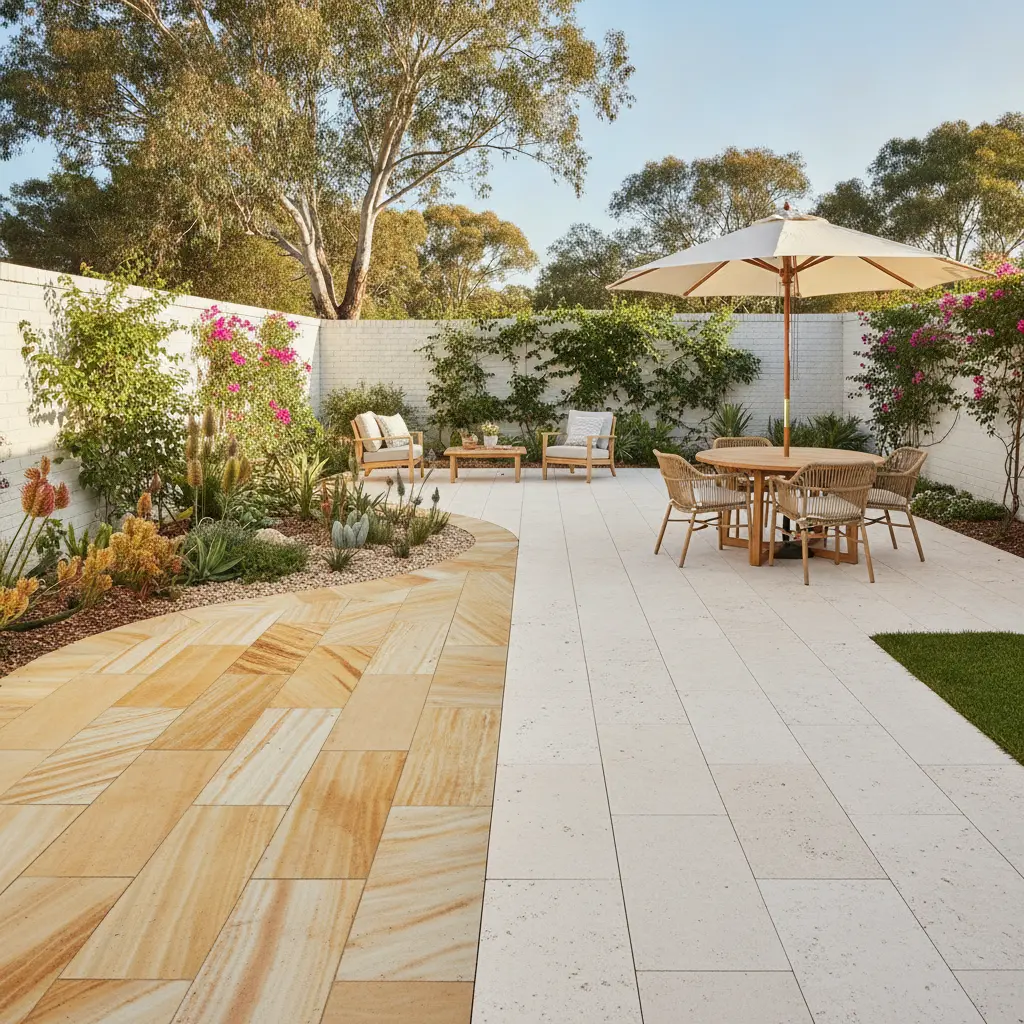
The short answer
Choose limestone if you want a soft, even cream or grey look with little colour movement, you can source a dense paving grade, and you will keep acidic cleaners and pool acid off it. Choose sandstone if you want quartz-based stone that is far less sensitive to the acids that etch limestone, warmer colour variation, thick pavers for driveways, and local supply in Sydney that matches heritage stone. Both are porous sedimentary stones that need sealing outdoors.
Which option suits which project
Sandstone
Best for: Sydney paving with colour variation, pools, driveways and heritage matching
View sandstoneLimestone
Best for: Even cream or grey paving where acids can be kept off the surface
Side-by-side comparison
| Sandstone | Limestone | |
|---|---|---|
| What it is | Quartz sand grains bound by natural cement | Calcium carbonate, often from shells and marine sediment |
| How it forms | Ancient sand beds compacted and naturally cemented | Shell, coral and lime mud compacted, or precipitated from water |
| Reaction to acid | Quartz is not etched; still never use acid cleaners | Etches and dulls with acids, including pool acid and vinegar |
| Hardness | Varies with the cement; cuts cleanly | Ranges from soft and chalky to dense and hard |
| Porosity | Porous; seal outdoor paving | Very porous to fairly dense, by type; seal outdoors |
| Colour | White, yellow, gold, brown, orange and purple; banding | Cream, white, beige and grey; usually even, often with fossils |
| Typical formats | 50mm pavers, 30mm tiles, flagging, 75–100mm for driveways | Commonly 20–30mm pavers and tiles; blocks in softer types |
| Heat underfoot | Pale colours stay comfortable | Pale colours stay comfortable |
| Slip when wet | Sandblasted gives the most grip; sawn is reliable | Depends on finish; honed dense limestone is smooth when wet |
| Pool use | Common for coping and surrounds with a salt-rated sealer | Possible with care; acid and salt can damage softer types |
| Where it is common | Sydney’s local building stone | Western Australia and South Australia, plus imported stone |
| Supply in Sydney | Quarried and cut to size at Glenorie | Mostly brought in from interstate or overseas |
| Cost (relative) | Guide prices from $65/m² to $120/m², stone only | Varies widely by grade and origin; compare quotes |
Sandstone prices are Stone Front guide prices for stone only, ex-quarry at Glenorie. Stone Front does not sell limestone; ask any limestone supplier for the specific stone’s density and water absorption.
What is limestone, and how is it different from sandstone?
Limestone is a sedimentary rock made mostly of calcium carbonate, usually built up from shells, coral and the skeletal fragments of marine organisms, or from lime mud that settled and hardened on old sea floors. Sandstone is also sedimentary, but it is made of sand grains, mostly quartz, bound together by natural cements such as silica, clay and iron oxides. So the two can look similar from a distance while being chemically quite different.
Two close relatives are worth knowing. Travertine is a limestone deposited by mineral springs, which is why it has natural holes. Marble is limestone that has been recrystallised by heat and pressure. All three share limestone’s main weakness: acid.
Why does acid matter so much for limestone?
Calcium carbonate reacts with acid, so anything acidic that sits on limestone dissolves a little of the surface and leaves a dull, pale etch mark. A penetrating sealer slows liquids from soaking in, but it does not stop that chemical reaction, so etching can still happen on sealed stone. Sandstone’s quartz grains are not etched in the same way, which makes it more forgiving outdoors, although acid cleaners can still discolour and damage sandstone and should never be used on it either.
Keep these off limestone, or rinse them off quickly:
- Hydrochloric (muriatic) acid used to balance pool water, and splashes when it is added.
- Acid-based brick, tile and grout-haze cleaners used after laying.
- Vinegar, lemon and other acidic household cleaners.
- Wine, citrus juice, soft drinks and some fertilisers.
- Rust and stain removers unless they are labelled safe for limestone.
For either stone, clean with a pH-neutral cleaner. The sandstone cleaning guide covers routine care and specific stains.
Is limestone good around a pool?
Dense, paving-grade limestone can be used around a pool with care, but softer, more porous limestones are a risk because both pool chemicals and salt attack them. Pool water is dosed with acid to keep its pH in range, and splashes land on the coping. In salt-water pools, salt crystals grow in the stone’s pores as splashes dry and can flake a soft surface over time. If you choose limestone, ask for its water absorption figure, choose a textured finish, seal it with a sealer rated for salt and chlorine, and rinse the coping with fresh water.
Sandstone is widely used for pool coping and surrounds in Sydney. Stone Front cuts coping 30–40mm thick and 400mm or 500mm wide with a bullnose, pencil-round or drop-face edge, and sandblasted sandstone is the most slip-resistant finish it offers. See sandstone pool pavers and the pool coping guide.
Which is harder and more durable?
Neither has a single answer, because both stones vary widely from quarry to quarry. Some limestones are so soft they can be cut with a hand saw and are used as building blocks, while dense limestones take a hone and wear well as floors. Sandstone’s hardness depends on how well its grains are cemented. Ask for the specific stone’s density and water absorption, and look at a sample: a dense, low-absorption stone generally wears better and stains less.
Thickness matters as much as the rock. For sandstone, use 50mm for paths, patios and pool surrounds, 75mm minimum where cars drive and 100mm for heavier vehicles or steep driveways. Thinner 30mm outdoor tiles go on a concrete slab. The paver sizes and thickness guide has the full table with weights.
Limestone pavers are commonly sold 20–30mm thick in sawn, honed, tumbled or brushed finishes and bedded on a slab, while softer local limestones are also cut into chunky blocks and thick pavers. Whichever stone you choose, match the finish to the job: a textured finish such as sandblasted or tumbled outdoors where it gets wet, and honed only where it stays dry or covered.
Why is limestone common in WA and SA but sandstone in Sydney?
Mostly geology: builders use the stone under their feet. Much of coastal Perth sits on limestone, so limestone blocks, walls and pavers are an everyday material there, and South Australia has well-known limestone areas such as Mount Gambier. Sydney sits in a sandstone basin, so its colonial buildings, sea walls, garden walls and steps are sandstone. Local stone is easier to supply, cheaper to freight and easier to match later, which is why limestone in Sydney is usually brought in from interstate or overseas, and why sandstone is the stone that matches existing Sydney work.
How do the looks, porosity and sealing compare?
Limestone usually reads as calm and even: cream, white, beige or soft grey, often with small fossil fragments. Sandstone has more movement, with iron banding and colour shifts from piece to piece. If you want sandstone with a quieter look, choose a single colour such as Marbled White or White with Greys in a honed or sawn finish; single-colour selections cost more than quarry-run, and the sandstone colour guide shows the range. Both stones are porous. Seal outdoor paving with a penetrating sealer on clean, dry stone, and reseal sandstone every 2–3 years outdoors; follow the sealer maker’s guidance for limestone.
Get a sandstone paving quote
Send Stone Front the product, area and your suburb through the sandstone paver quote form, and you will usually hear back the same business day. Quarry visits at Glenorie can be booked when you ask for the quote if you want to see the colours first.
To compare a limestone quote fairly, ask for the same thickness, finish and size, check whether delivery is included, and add the base each option needs: thin limestone on a new slab usually costs more to prepare than 50mm sandstone on a compacted base. Allow extra stone for cuts too: about 5% for stack bond and 10–15% for herringbone or diagonal layouts.
Frequently Asked Questions
How can I tell limestone from sandstone?
Put a drop of vinegar on an offcut or hidden spot: limestone fizzes or etches because it is calcium carbonate, while quartz sandstone does not. Sandstone also feels gritty, like fine sandpaper, and its grains catch the light, whereas limestone usually feels smoother and may show fossil fragments.
Can sandstone be finished to look like limestone?
It can come close. Choose a pale single colour such as Marbled White or White with Greys and a honed or sawn finish for a calm, even surface. Honed gives less grip outdoors, so use sawn or sandblasted where it gets wet. Single-colour selections cost more than quarry-run pallets.
Do limestone and sandstone pavers grow moss or algae?
Both can in damp, shady spots because they are porous and hold moisture. Good falls, drainage and airflow help most. Clean with a product labelled safe for the stone, avoid acid-based cleaners on either, and keep a penetrating sealer in good condition so water does not sit in the surface.
Is limestone cheaper than sandstone?
It varies widely with grade, origin and freight, so get written quotes at the same thickness and finish. Stone Front’s sandstone starts from $65/m² for sawn modular paving, $85/m² for sawn flagging and $120/m² for sawn all round pavers, guide prices for stone only, ex-quarry at Glenorie.