Retaining Wall Ideas: 12 Ways to Use Sandstone
Twelve sandstone retaining wall ideas, from terraces and seat walls to boulder, log, gabion and lit walls, with the stone, guide prices and links for each.
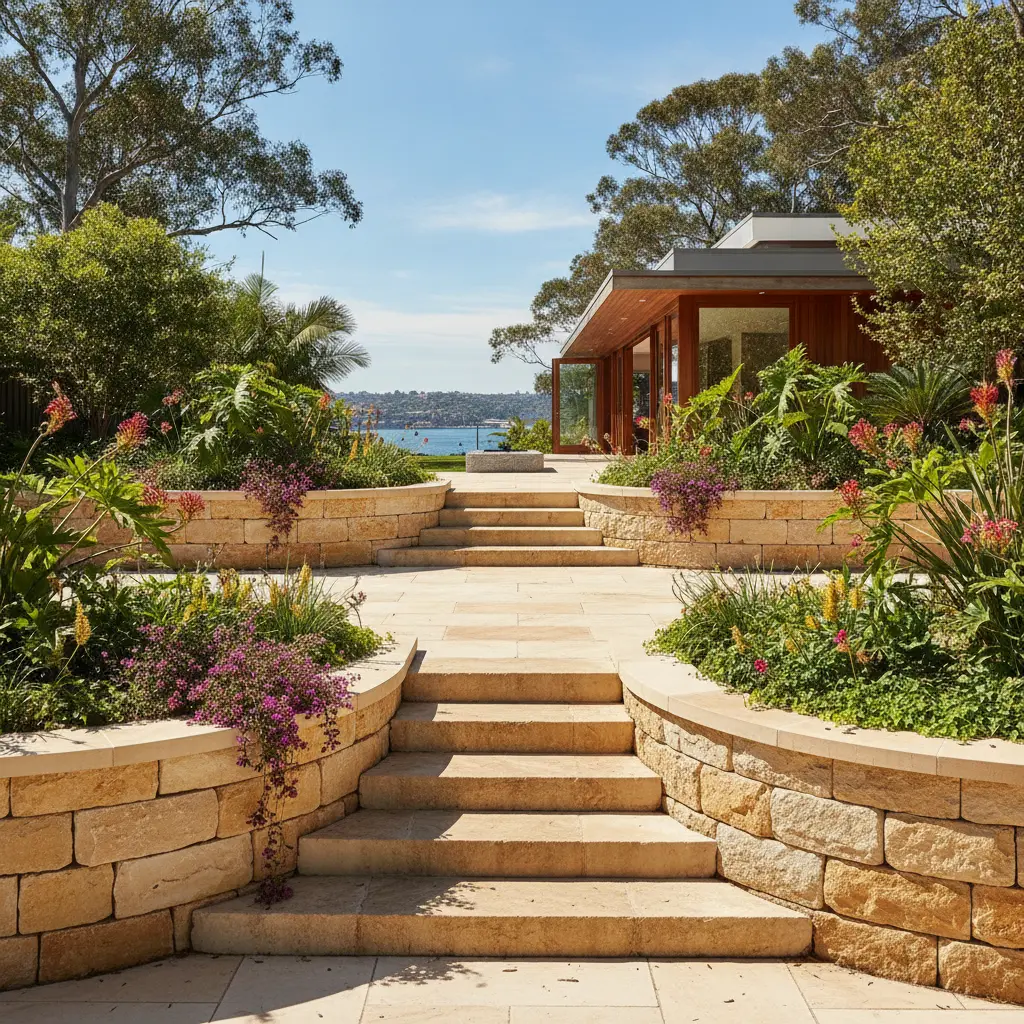
Twelve retaining wall ideas that work well with sandstone are terraced walls, stepped garden beds, walls with built-in steps, log walls, billet walls, seat-height walls with capping, planter walls, lit walls, curved boulder walls, dry-stacked walls, gabions filled with sandstone spalls and feature walls that mix finishes. Stone starts from $120/m² of wall face for rough squared blocks (guide price).
- Lowest-cost blocks: rough squared blocks from $120/m² of wall face; rockfaced from $180/m², hydrasplit from $190/m², sawn all round from $250/m²
- Logs: about 300 x 300mm, so three courses make roughly 900mm of wall
- Approvals: most NSW councils require approval for walls over about 600mm or near a boundary; engage an engineer for walls over about 1m
Which retaining wall ideas suit a sloping block?
On a sloping block, the ideas that suit it break one big change in level into several smaller ones. Lower walls are easier to build, often avoid engineering, and turn a bank you cannot use into flat garden you can.
1. Terraced walls
Instead of one tall wall, build two or three low walls with planted terraces between them. Two 600mm walls look lighter than one 1.2m wall and leave room for planting that softens the stone. Space the tiers well apart: walls built close together can act structurally as one tall wall, so ask your council or engineer how far apart yours need to be. Rockfaced blocks or rough squared blocks suit terraces; see our sandstone retaining walls page for options.
2. Stepped garden beds
Where a wall runs down a slope, step the top and the footing down with the ground, one course at a time. Each step creates a level bed that holds water and mulch. Block heights of 100, 150, 200 and 250mm let you match almost any fall, which is why sandstone retaining wall blocks are the usual choice here.
3. Block walls with built-in steps
Cut a flight of steps through the wall rather than walking around it. Solid sawn block steps are typically 1000–1200mm long with a 300–350mm going and 150–175mm rise, and the wall returns on either side to hold the soil. Our guide to building sandstone steps covers the sizes and the 2R + G rule.
4. Sandstone log walls
Split logs about 300 x 300mm build height fast: three courses give roughly 900mm, and a single-skin log wall typically reaches about 1m before engineering is needed. Each metre of log weighs about 207kg, so they go in with small machinery. See how to build a sandstone log retaining wall.
5. Billet walls for big cuttings
For deep driveway cuttings and commercial batters, sandstone billets are large-format pieces, often around a tonne each, placed by machine. A 1,200 x 600 x 600mm billet weighs about 994kg. Walls of this scale need an engineer’s design.
How can a retaining wall do more than hold back soil?
A retaining wall can also be seating, a garden bed or a lighting feature if you plan its height, top and face from the start.
6. Seat-height walls with capping
Build the wall to around 450mm, a comfortable seat height, and finish it with sawn capping wide enough to sit on, such as 350 or 400mm. Capping is usually 30–50mm thick and cut to the wall width plus about 20–30mm overhang each side; a bullnose edge is kind to the backs of legs. Our sandstone wall capping guide covers widths and fixing.
7. Planter walls and raised beds
A low wall around a raised bed is a retaining wall in miniature. Line the inside face with a waterproof membrane or geotextile so wet soil does not sit against the stone, which reduces staining, and leave a drainage path at the base. Hydrasplit blocks, from $190/m² of wall face, give a crisp, modern planter.
8. Lit walls with solar wall lights
Lighting turns a wall into a night-time feature and marks the level change for safety. The Solar Wall Wash Light throws a warm wash down the face, and solar step lights mark built-in steps; both are IP65. The Retaining Wall Lighting Kit groups lights for this job, and our retaining wall lighting ideas show placement.
Which retaining wall ideas give a natural or distinctive look?
Natural-looking walls rely on irregular stone and soft planting; distinctive walls rely on contrast in texture and finish.
9. Curved boulder walls
Boulders follow curves that blocks cannot, so they suit informal gardens and bush blocks. Select boulders are more shaped and stack into a structured wall; 1–2 man boulders suit low edges. Our guide to landscaping with sandstone boulders covers sizes and placement.
10. Dry-stacked rough squared walls
Rough squared blocks laid without mortar give a cottage-garden wall with deep shadow lines. They come four layers to a pallet (about 4m² of wall face) or loose by the tonne, hand-selected at the quarry. Keep dry-stacked walls low; our guide to stacked sandstone and dry stone walls explains how they are built.
11. Gabion walls with sandstone spalls
Wire baskets filled with 75–150mm gabion spalls make a modern, free-draining wall. A 2m x 1m x 0.5m basket takes about 1.5 tonnes of spalls. Gabions are often topped with timber or sandstone to make a bench.
12. Feature walls with mixed finishes
Pair rockfaced blocks with sawn capping, add a band of hydrasplit through a rockfaced wall, or use sawn all round blocks for a clean modern face. Keep to two or three finishes in one garden so the result looks planned. Compare them on our sandstone finishes page.
How much do these retaining wall ideas cost?
Stone for a sandstone retaining wall starts from $120/m² of wall face, and the type of stone sets most of the material cost. A 10m wall 800mm high has 8m² of face: about $960 of stone in rough squared blocks or $1,440 in rockfaced blocks at guide prices, before capping, drainage, delivery and labour.
| Idea | Main stone | Guide price (stone only) |
|---|---|---|
| Terraced walls, stepped beds | Rough squared or rockfaced blocks | From $120 or $180/m² of wall face |
| Planter and modern walls | Hydrasplit blocks | From $190/m² of wall face |
| Feature walls | Sawn all round blocks | From $250/m² of wall face |
| Log walls | Split logs, about 300 x 300mm | By quote |
| Boulder walls | Select or 1–2 man boulders | By quote |
| Gabion walls | Gabion spalls, 75–150mm | By quote, about 1.5t per 1m³ basket |
| Big cuttings | Sandstone billets | By quote |
| Seat walls | Sawn capping, 30–50mm | By quote per lineal metre |
For the full breakdown, read sandstone retaining wall cost. If you are still weighing sandstone against concrete blocks or sleepers, see retaining wall blocks compared.
What does every retaining wall need, whatever the design?
Every retaining wall needs a firm footing, drainage behind it and the right approvals, whatever it looks like. The design ideas above only last if these are right.
- Footing: dig into firm, undisturbed ground and compact a level base of road base or crushed sandstone; taller walls and walls on clay usually need a concrete footing to an engineer’s design.
- Drainage: lay slotted ag pipe at the base, backfill with free-draining gravel wrapped in geotextile, and lead the pipe to a legal outlet. Trapped water is the usual reason walls lean or bulge.
- Approvals: most NSW councils require approval for walls over about 600mm or near a boundary, so check your council before you start.
- Engineering: engage an engineer for walls over about 1m, or any wall holding up a driveway, pool or building.
Get sandstone for your retaining wall
Measure the wall length and height, pick an idea, and use the sandstone block calculator to estimate blocks or pallets. Then request a quote with the product, quantity and your suburb; Stone Front usually replies the same business day. You can also visit the Glenorie quarry by arrangement to hand-select blocks and boulders.
Frequently Asked Questions
What is the cheapest sandstone retaining wall idea?
On Stone Front guide prices, rough squared blocks are the lowest-cost block, from $120/m² of wall face, and they suit dry-stacked and terraced walls. Boulders, logs and gabion spalls are priced by quote, so ask for each option priced for the same wall length and height and compare them with installation costs included.
How do I make a retaining wall look less imposing?
Break the height into two or three lower terraces, plant the beds so foliage spills over the top, and curve the line rather than running it dead straight. A sandstone capping and a warm wash of light at night also soften a wall by giving the eye a finished edge to rest on.
Can I mix sandstone blocks and boulders in one wall?
You can, but it works better as a deliberate change rather than a random mix. A common approach is a block wall near the house, where the garden is more formal, that gives way to boulder walls further out. Keep the colours from the same quarry so the two materials read as one landscape.
What plants suit the top of a sandstone retaining wall?
Low, spreading plants that tolerate dry, well-drained soil suit the top of a wall, because a wall bed drains quickly and gets reflected heat. Groundcovers and small native shrubs that cascade over the face soften the stone. Keep large trees well back from the wall, as their roots and weight add load.
Can I build a sandstone retaining wall myself?
Low walls of rough squared or rockfaced blocks, which can be placed by hand, are within reach of a careful DIYer. Logs, billets and large boulders need machinery. Walls over about 600mm or near a boundary usually need council approval, and walls over about 1m need an engineer, so most people use a landscaper for those.
Products Mentioned in This Article
Rough Squared Blocks
Economical blocks for retaining walls and garden projects.
Rockfaced Blocks
Traditional rockfaced finish blocks for walls, edging and complete homes.
Hydrasplit Blocks
Modern split-face blocks for contemporary walling projects.
Split Logs (Sandstone Logs)
Approximately 300x300mm logs for retaining walls and stepped landscapes.
Sandstone Boulders
Natural boulders from gabion-size to large feature rocks.
Gabion Spalls
Small sandstone boulders (75-150mm) for gabion baskets and decorative walls.