Driveway Pavers Compared: Sandstone, Brick, Concrete or Setts?
Sandstone, concrete pavers, recycled brick, stone setts or a concrete slab: thickness and base for cars, oil stains, cracking, repairs and relative cost.
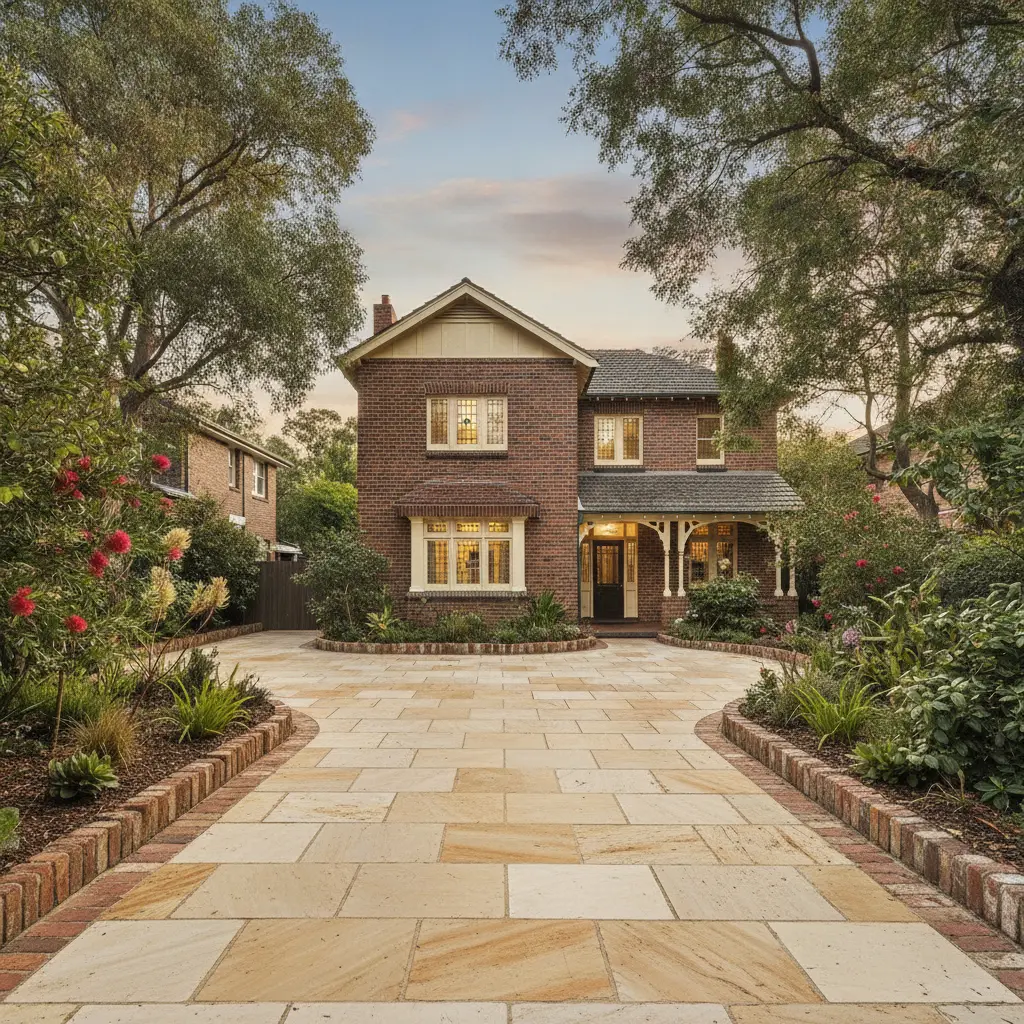
The short answer
Choose 75–100mm sandstone pavers if you want a natural stone driveway that suits a sandstone or heritage home and can be lifted and relaid. Choose concrete pavers for a lower-cost, uniform unit paver. Choose recycled bricks laid on edge in herringbone for period character. Choose granite or bluestone setts for a hard-wearing feature that hides stains. Choose a plain or exposed-aggregate slab for the lowest upfront cost, accepting cracks and visible repairs.
Which option suits which project
Sandstone pavers
Best for: Natural stone drives for sandstone and heritage homes
View sandstone paversConcrete pavers
Best for: Lower-cost, uniform unit paving for long drives
Recycled brick pavers
Best for: Period character on Federation and Victorian homes
View recycled brick paversGranite or bluestone setts
Best for: Hard-wearing feature aprons and cobbled looks
Concrete slab
Best for: The lowest upfront cost on long, plain drives
Side-by-side comparison
| Sandstone pavers | Concrete pavers | Recycled brick pavers | Granite or bluestone setts | Concrete slab | |
|---|---|---|---|---|---|
| What it is | Sawn or split natural sandstone, 75–100mm thick | Factory-made interlocking or rectangular units | Reclaimed clay bricks laid on edge | Small, roughly cubic blocks of very hard stone | Poured reinforced concrete, plain or exposed aggregate |
| Thickness for cars | 75mm minimum; 100mm for heavy or steep | Vehicle ranges commonly 60–80mm | About 110mm deep on edge | Varies with sett size | Commonly 100mm or more, reinforced |
| Base | 150–200mm compacted road base or reinforced slab | Compacted road base, bedding sand, edge restraint | Compacted base, sand bed, firm edge restraint | Usually mortar on a concrete slab | Compacted subgrade and crushed rock |
| Oil stains | Porous: seal and blot spills quickly | Stains, but units can be swapped | Stains blend into weathered brick | Dense and textured; shows little | Stains readily; hard to remove fully |
| Cracking and movement | Flexible on sand; on a slab follows the slab | Flexible; joints absorb movement | Flexible; herringbone resists creep | Rigid bed can crack with the slab | Cracks; control joints guide where |
| Repairs | Lift and relay; keep spare pavers | Lift and relay single units | Lift and relay; reclaimed bricks blend in | Chip out and reset in mortar | Patches show; bays often replaced |
| Kerb appeal | Warm natural stone that suits Sydney homes | Neat and uniform, many colours | Warm red period character | Old-world cobbled texture | Plain; exposed aggregate adds texture |
| Laying | Heavy stone; skilled cutting | Quickest of the unit pavers | Labour-intensive; many herringbone cuts | Slow, skilled work | Trade job: formwork, pour and finish |
| Relative cost | Mid to high; priced by thickness | Usually below natural stone | About $81/m² of bricks on edge (guide) | Usually the highest per m² | Plain slab usually lowest |
| Best for | Sandstone and heritage homes, curved drives | Budget drives and long runs | Federation, Victorian and terrace frontages | Entry aprons, borders and feature strips | Long, plain drives on a budget |
| Sold by Stone Front | Yes | No | Yes | No | No |
Thicknesses and bases are general guides; your installer or engineer sets the final specification for your soil and vehicles.
Driveway pavers carry car loads, turning tyres and oil drips for decades, so thickness and base matter far more than on a patio. Five options cover most Sydney driveways: sandstone pavers, concrete pavers, recycled bricks laid on edge, granite or bluestone setts, and a poured concrete slab, plain or exposed aggregate. Here is how they compare.
What are the main driveway paving options?
The main driveway paving options are natural stone pavers, manufactured concrete pavers, clay bricks, stone setts and poured concrete. Sandstone driveway pavers are sawn modular paving, sawn flagging or track-grade handsplit flagging 75–100mm thick. Concrete pavers are factory-made units, often in interlocking shapes, made in vehicle-rated thicknesses. Recycled bricks are reclaimed clay bricks cleaned of lime mortar and laid on edge, usually in herringbone. Setts are small, roughly cubic blocks of very hard stone such as granite or basalt. A poured slab is reinforced concrete finished plain, broomed, coloured or with the surface washed off to expose the aggregate.
How thick should driveway pavers be, and what base do they need?
Driveway pavers need to be thicker than path pavers and sit on a deeper, compacted base. For sandstone, use 75mm minimum where cars drive and 100mm for heavier vehicles or steep driveways, on 150–200mm of compacted road base or a reinforced concrete slab.
| Option | Typical thickness for cars | Usual base |
|---|---|---|
| Sandstone pavers | 75mm; 100mm for heavy or steep | 150–200mm compacted road base or reinforced slab |
| Concrete pavers | Commonly 60–80mm vehicle ranges | Compacted road base, bedding sand, edge restraint |
| Recycled bricks on edge | About 110mm deep | Compacted base, screeded sand, firm edge restraint |
| Granite or bluestone setts | Varies with sett size | Usually a mortar bed on a concrete slab |
| Concrete slab | Commonly 100mm or more, reinforced | Compacted subgrade and crushed rock |
Edge restraints matter for every unit paver: without a concrete haunch or kerb along the sides, pavers creep outwards under tyres. Our sandstone driveway guide covers base depths, edging and falls in detail.
Steep driveways need extra care whatever the material. Use the thicker end of the range, such as 100mm sandstone, a rigid or very well-compacted base and a textured surface that tyres and shoes can grip. Water running down a long slope also needs somewhere to go, so plan a grated strip drain across the bottom of the drive and at the garage door, and fall the paving away from the house.
Which driveway pavers hide oil stains best?
Dense, darker or textured surfaces hide oil stains best, so granite and bluestone setts and weathered recycled bricks show drips least, while pale, porous surfaces show them most. Sandstone is porous, so seal driveway pavers with a penetrating sealer and blot spills quickly; sealing buys you time to clean oil before it soaks in. Concrete pavers stain too, but a badly marked paver can be lifted and swapped. A poured slab is the hardest to fix, because oil soaks into the concrete and cleaning often leaves a lighter patch.
On any surface, act quickly: soak up fresh oil with an absorbent such as kitchen paper or cat litter, then wash the area with a degreaser suited to the material. Never use acid cleaners on sandstone, and test any cleaner on a spare paver first.
Do paved driveways crack less than concrete slabs?
Pavers laid on a flexible sand bed rarely crack the way a slab does, because the joints let the surface move slightly with the ground. A poured slab is rigid: shrinkage, reactive clay soils and tree roots eventually crack it, and control joints are cut so cracks form in straight, planned lines. Any paving set in mortar on a slab, including setts and some sandstone driveways, follows the slab, so a crack below can show through the joints above. Where the ground moves, flexible pavers sink or lift locally instead of cracking.
Repairs follow the same pattern. Unit pavers can be lifted, the base fixed and the same pavers relaid, so keep a few spares from the original order. Concrete patches rarely match the surrounding colour or finish, so slab repairs often mean cutting out and replacing a whole bay.
Which driveway paving ideas add kerb appeal?
Materials that match the house add the most kerb appeal, because the driveway is often the largest hard surface on the frontage. Ideas that work on Sydney homes:
- Sandstone with a sandstone or heritage house: the driveway picks up the walls, steps and edging in the same stone. See sandstone driveway pavers for formats and thicknesses.
- Recycled bricks for Federation and Victorian homes: warm red recycled brick pavers laid in herringbone suit period frontages, and our recycled brick driveway guide covers patterns, quantities and base.
- Mixed materials: a concrete or exposed-aggregate drive with sandstone or brick borders, or a band of setts at the entry, adds texture without paving the whole area in stone.
- Crazy-paved drives: 75–100mm sawn flagging on a slab gives a jigsaw look; see crazy pavers compared.
- Edge lighting: low solar lights along the edge mark the driveway line at night; see the driveway edge and path kit.
How much do driveway pavers cost?
A plain concrete slab is usually the cheapest driveway per square metre, exposed aggregate costs more, and stone setts usually cost the most. Concrete pavers generally sit below natural stone. Recycled brick pavers are $1.50 each (guide price), which is about $81 per m² of bricks laid on edge at 54 per m². Sandstone sawn modular paving starts from $65/m² at 50mm, and the 75mm and 100mm thicknesses that driveways need cost more because they contain more stone, so Stone Front quotes them by area and thickness. Excavation, base, edge restraints and labour often cost as much as the paving itself, so compare complete quotes.
Get a quote for sandstone driveway pavers
Send the driveway area, thickness, preferred product and suburb through the driveway paver quote form, and Stone Front usually replies the same business day.
Frequently Asked Questions
Can sandstone pavers go over an existing concrete driveway?
Yes, if the slab is sound, reasonably level and drains. The pavers are bedded in mortar on the slab, which then carries the load. Check finished heights at the garage door, house and footpath before committing, and expect existing cracks in the slab to reflect through the joints above.
Do I need council approval for a new driveway?
It depends on your council and site, but most NSW councils require an application for the driveway crossing between your boundary and the kerb, because that section sits on council land. Rules can be stricter in heritage conservation areas, so check with your council before ordering materials.
Is crushed sandstone an option for a driveway?
Yes, especially on rural and acreage properties. Compacted 75mm minus crushed sandstone forms a firm, free-draining driveway surface, often over 150mm minus where levels need building up. It costs less than paving but needs topping up and regrading over time, and it is less suited to steep drives where water scours the surface.
How heavy is the stone for a sandstone driveway?
Sandstone 75mm thick weighs about 173kg per m² and 100mm about 230kg per m². A 40m² driveway in 75mm pavers is therefore about 6.9 tonnes of stone, so it is delivered by flatbed or crane truck, and the drop point needs about 3.5m of width and firm ground.
Which paving pattern is strongest for a driveway?
For small units such as concrete pavers and bricks, herringbone laid at 45 or 90 degrees to the direction of travel interlocks best and resists creeping under turning tyres. Larger sandstone pavers rely more on their thickness and base, so 75–100mm stone on a well-compacted base or slab matters more than the pattern.