Sleeper vs Sandstone Retaining Walls: Concrete, Timber or Stone?
Concrete sleepers, treated pine, hardwood or sandstone logs: how each retaining wall is supported, what rots or rusts, and which is cheapest over its life.
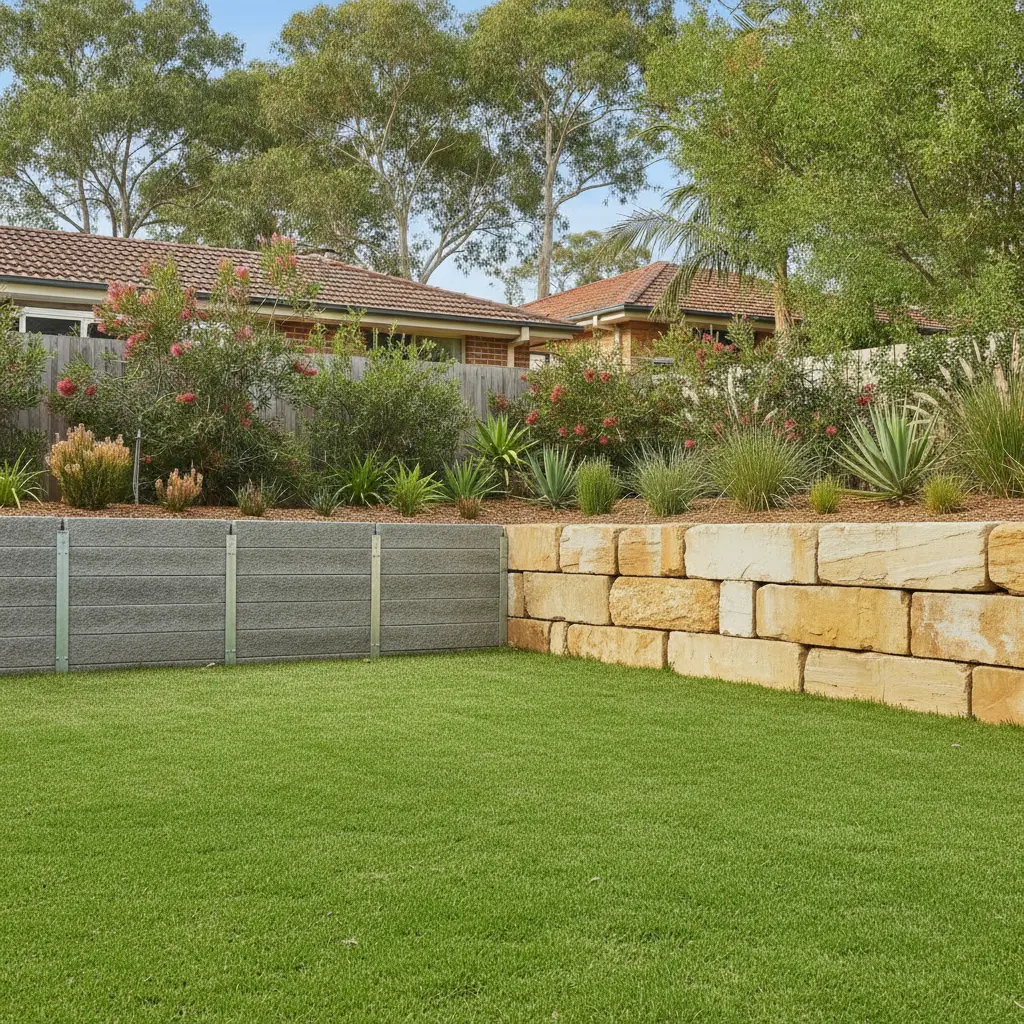
The short answer
Choose sandstone logs or blocks if you want a retaining wall that will not rot, rust or need rebuilding and you can pay more upfront. Choose concrete sleepers with galvanised steel posts for a long, straight wall at a mid-range price with a long service life. Choose H4-treated pine for low, budget walls you accept will one day need replacing. Choose hardwood sleepers when you want a timber look that outlasts treated pine.
Which option suits which project
Sandstone logs or blocks
Best for: Permanent walls that never rot or rust and suit natural gardens
View sandstone logs or blocksConcrete sleepers
Best for: Long, straight walls with a long life at a mid-range price
Treated pine sleepers
Best for: Low, short-term walls on the tightest budget
Hardwood sleepers
Best for: Rustic timber walls that outlast treated pine
Side-by-side comparison
| Sandstone logs or blocks | Concrete sleepers | Treated pine sleepers | Hardwood sleepers | |
|---|---|---|---|---|
| What it is | Solid stone logs (300 x 300mm) or blocks stacked in courses | Precast reinforced concrete sleepers between steel posts | H4-treated softwood sleepers between posts | Dense Australian hardwood sleepers between posts |
| Typical size | Logs about 300 x 300mm, 1–2m long | Usually 200mm high; length suits post spacing | Commonly 200mm high, 50 or 75mm thick | Commonly 200mm high; thicker sections available |
| What holds it up | Weight of stone on a concrete footing | Steel posts concreted into holes | Timber or steel posts concreted in | Timber or steel posts concreted in |
| Posts needed | None | Galvanised steel H or C posts | H4/H5 timber or galvanised steel | Hardwood or galvanised steel |
| Rot, termites, rust | None of these | Sleepers don’t rot; damaged galvanising can rust | Will eventually rot; cut ends need sealing | Slower to decay than pine, but still timber |
| Look | Natural stone that weathers into the garden | Plain grey or moulded stone and timber textures | Green-tinged timber that greys | Rich timber that greys; tannin can stain |
| Height before engineering (general) | Single-skin logs to about 1m | Check council; engineer over about 1m | Check council; engineer over about 1m | Check council; engineer over about 1m |
| Upfront cost (relative) | Highest of the four | Mid | Lowest | Low to mid |
| Whole-of-life cost (relative) | Low: no rebuild expected | Low to mid | Highest once replacement is counted | Mid |
| DIY difficulty | Logs need machinery; blocks can be hand-laid | Moderate: heavy, accurate post holes critical | Easiest: light and cut with a saw | Moderate: heavy, hard to cut, may twist |
| Best for | Permanent garden walls, heritage and bushland settings | Boundary walls and long straight runs | Low garden beds and temporary walls | Rustic gardens where timber suits |
| Sold by Stone Front | Yes: split logs and blocks | No | No | No |
Costs are relative and vary by site. Most NSW councils require approval for retaining walls over about 600mm or near a boundary; engage an engineer for walls over about 1m.
A sleeper retaining wall is built from long horizontal units stacked in courses, usually held up by posts set in concrete. The material you choose, whether concrete, treated pine, hardwood or sandstone, decides how the wall is supported, what wears it out and what it really costs over its life. For sizes, weights and quantities of the stone version, see our sandstone sleepers guide; this page focuses on how the four materials compare.
How are sleeper retaining walls supported?
Concrete and timber sleeper walls are post-and-panel walls: vertical posts are concreted into holes and the sleepers slot between them or fix behind them, so the posts carry the soil load. Sandstone sleepers, more accurately split sandstone logs, need no posts. They are gravity walls stacked on a concrete footing, and the weight of the stone, about 207kg per lineal metre of log, resists the soil.
For concrete sleepers, the posts are usually galvanised steel H-section or C-section posts, spaced to suit the sleeper length (commonly 2m or 2.4m) so each sleeper drops into the flanges. Timber sleepers can use timber posts or the same steel posts. The post holes are the critical part: a common rule of thumb is to sink each post about as deep as the height it retains, but the engineer’s design or the post supplier’s table sets the real depth and hole diameter for your soil and height. Posts must be plumb and in line, because sleepers cannot correct a crooked post.
A sandstone log wall instead needs a continuous concrete footing, with the first course bedded on it and each course set back slightly into the slope. Our guide to building a sandstone log retaining wall walks through the footing, drainage and setback.
Do sleeper walls rot, rust or attract termites?
Timber sleepers eventually rot and can be attacked by termites, steel posts can rust where their coating is damaged, and sandstone does neither. How quickly it happens depends on the treatment, the drainage and the soil.
- Treated pine: use sleepers and posts treated to at least H4, the hazard class for timber in ground contact; structural posts are often specified at H5. Treatment only penetrates so far, so seal every cut end and drill hole with an end-sealing preservative. Damp soil against the back face is what eventually breaks the timber down.
- Hardwood: dense Australian hardwoods have natural durability and outlast untreated softwood, but they are still timber and will decay in permanently damp ground and can still be attacked by termites. Hardwood also bleeds tannin, which can stain paving and render below the wall.
- Concrete sleepers with steel posts: the sleepers do not rot, but the posts must be hot-dip galvanised. Cutting a post or scratching the coating exposes bare steel, so touch up with cold galvanising paint. Concrete sleepers can crack if overloaded or poorly supported.
- Sandstone: solid stone does not rot, rust or feed termites. Keep the drainage clear and the wall has very little to wear out.
How high can a sleeper retaining wall be?
Most NSW councils require approval for retaining walls over about 600mm or close to a boundary, and you should engage an engineer for walls over about 1m, whether they are timber, concrete or stone. Check your council before you dig, especially for walls on or near a boundary.
Within those limits, the post matters more than the sleeper on post-and-panel walls: taller walls need bigger posts, deeper holes and closer spacing, all set by the engineer. A single-skin sandstone log wall typically reaches about one metre before engineering is needed; above that, the wall is redesigned with more setback, a second skin or engineered billets. Loads near the top of any wall, such as a driveway, shed or pool, reduce the safe height. Our sandstone log retaining wall page shows typical heights and courses.
What is the cheapest retaining wall?
A treated pine sleeper wall is usually the cheapest retaining wall to build upfront, but it is rarely the cheapest over the life of the property, because timber eventually has to be replaced, which means demolition, disposal and a second build. The order below is a general guide; get quotes for your own site.
| Wall type | Upfront cost (relative) | Rebuild risk | Whole-of-life cost (relative) |
|---|---|---|---|
| Treated pine sleepers | Lowest | High: timber eventually rots | Highest once a rebuild is counted |
| Hardwood sleepers | Low to mid | Moderate: slower to decay | Mid |
| Concrete sleepers, steel posts | Mid | Low while posts stay galvanised | Low to mid |
| Sandstone logs or blocks | Highest | Very low | Low |
Sandstone blocks start from $120/m² of wall face (guide price, stone only) and split logs are priced by quote. Labour often decides the real gap: post-and-panel walls are quick on easy ground, while logs go in fast wherever a small machine can reach. For the two stone options side by side, read sandstone logs vs blocks.
Can I build a sleeper retaining wall myself?
A low treated pine sleeper wall is the most DIY-friendly option, because the sleepers are light enough for one or two people and cut with a circular saw. Concrete sleepers are heavy, typically a two-person lift, and the job hinges on accurate, plumb post holes, so many owners hire a post-hole borer or a contractor for that step. Hardwood is heavy, hard to cut and can twist as it dries. Sandstone logs need a small excavator or loader and an operator who has placed stone before, while sandstone blocks can be laid by hand and suit patient DIYers building low walls.
Get a quote for a sandstone sleeper wall
Send your wall length, height and suburb through the split log quote form and Stone Front usually replies the same business day. Still choosing a wall system? See retaining wall blocks compared.
Frequently Asked Questions
Do sleeper retaining walls need drainage?
Yes. Every sleeper wall needs free-draining gravel directly behind it and a slotted ag pipe at the base, run to stormwater or a safe outlet. Without drainage, water pressure builds up behind the wall, pushing posts out of line, rotting timber faster and staining stone. Geotextile fabric stops soil clogging the gravel.
Can I replace a timber sleeper wall with sandstone?
Yes. Remove the old sleepers and posts, then pour a continuous concrete footing for the stone, because sandstone logs and blocks stand on a footing rather than posts. Clear old post holes of rotten timber and backfill them firmly. Check whether the new wall height needs council approval before work starts.
Do concrete sleepers come in a sandstone look?
Many concrete sleeper ranges are moulded with sandstone, rock or timber textures and come in tinted colours, which softens the look of a plain grey wall. They are still a uniform, repeating moulded face, so they read differently from real split stone, especially up close and as the tint weathers.
How many sandstone logs do I need for a sleeper-style wall?
Each course of 300 x 300mm logs adds about 300mm of height, so multiply the wall length by the number of courses to get lineal metres. A 10m wall 900mm high is 3 courses, 30 lineal metres and about 6 tonnes of stone, so plan machine access and delivery early.
Are steel posts better than timber posts for a sleeper wall?
Hot-dip galvanised steel posts do not rot or attract termites, so they usually outlast timber posts, and they work with both concrete and timber sleepers. Their weak points are cut ends and scratched coatings, which can rust if left untreated. Timber posts cost less and are easier to fix to, but share timber’s decay risk.