Landscaping with Sandstone: Every Use, Product and Price
Every way sandstone is used in a garden, from paving, steps and walls to boulders and crushed sandstone paths, with the product, quantity and guide price for each.
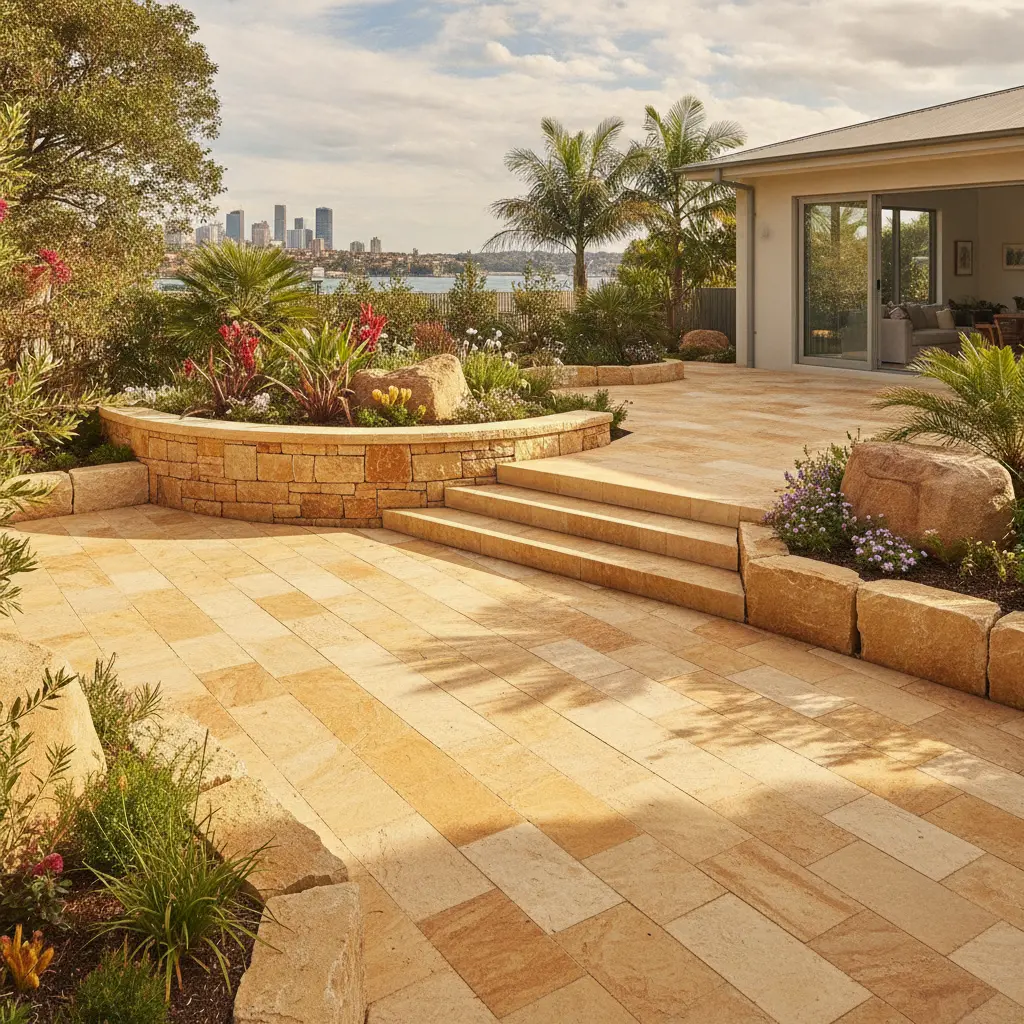
Sandstone is used in landscaping for paving, steps, edging, retaining and garden walls, boulders, stepping stones, crushed sandstone paths, capping, benches and gabion walls. In Sydney, stone from Stone Front’s Glenorie quarry starts from $65/m² for sawn modular paving, $35 per lineal metre for edging and $120/m² of wall face for rough squared blocks (guide prices, stone only).
- Paving: 50mm for foot traffic, 75mm minimum for cars, 100mm for heavier vehicles
- Walls: sold by the square metre of wall face; logs by the lineal metre
- Bulk: crushed sandstone, boulders and gabion spalls by the tonne
- Colours: ten quarry colours; quarry-run pallets blend them and are the most economical
How is sandstone used in landscaping?
Sandstone covers almost every hard surface in a garden, from the paving underfoot to the walls, steps and edges that shape it. The table matches each use to the product and points to the guide that covers it in depth.
| Use | Sandstone product | Guide price (stone only) | More detail |
|---|---|---|---|
| Patios and courtyards | Sawn all round pavers, outdoor tiles | From $120/m², tiles from $110/m² | Patio ideas |
| Budget paving | Sawn modular paving | From $65/m² (50mm) | Cheap pavers |
| Crazy paving | Sawn flagging, handsplit flagging | From $85/m²; handsplit by quote | Crazy paving |
| Driveways | 75 or 100mm sawn paving, track handsplit | By quote for 75–100mm | Driveway guide |
| Pool surrounds | Sandblasted or sawn pavers, pool coping | Pavers from $120/m²; coping by quote | Pool pavers |
| Steps | Solid block steps, treads, log steps | By quote per piece | Sandstone steps |
| Garden edging | Sawn and hydrasplit edging | From $35 per lineal metre | Edging ideas |
| Retaining walls | Rough squared, rockfaced, hydrasplit blocks; logs | From $120/m² of wall face | Retaining walls |
| Boulders and rock gardens | 1–2 man, select and feature boulders | By quote | Boulder guide |
| Stepping stones | Sawn or split steppers | By quote | Stepping stones |
| Paths and bases | Crushed sandstone 75mm minus | By quote per tonne | Crushed sandstone |
| Wall capping | Sawn capping, 30–50mm | By quote | Capping guide |
| Benches and letterboxes | Custom stonemasonry | By quote | Benches and pillars |
| Gabion walls | Gabion spalls, 75–150mm | By quote | Gabion rocks |
Which sandstone should you use for paving and paths?
Choose sandstone paving by the look you want and the traffic it will carry. For a formal patio or pool surround, sawn all round pavers (popular in 400x400, 600x400 and 600x600mm at 50mm) give clean lines; sandblasted is the most slip-resistant finish for wet areas. For a lower stone cost, sawn modular paving in mixed sizes and colours starts from $65/m². Hydrasplit paving, 50mm and split to any width, from $95/m², suits linear paths and borders. Crazy paving in sawn flagging, from $85/m², suits informal paths and courtyards.
Thickness follows the load: 50mm for paths, patios and pool surrounds, 75mm minimum where cars drive, and 100mm for heavier vehicles or steep driveways. Thinner 30mm outdoor tiles are bedded on a concrete slab. Our guide to sandstone paver sizes and thickness has the full table, how to lay sandstone pavers covers bases and falls, and how to joint sandstone pavers covers the gaps between them.
Which sandstone works for walls, edging and capping?
Use blocks or logs for walls, cut strips for edging and sawn slabs for capping. Standard blocks have a 110mm bedwidth, the same as a brick, in 100, 150, 200 and 250mm heights, and are sold by the square metre of wall face: rough squared from $120/m², rockfaced from $180/m², hydrasplit from $190/m² and sawn all round from $250/m². Split logs, about 300 x 300mm and 207kg per metre, build a retaining wall in 300mm courses with small machinery. For a natural dry wall, see stacked sandstone and dry stone walls; for design ideas, see retaining wall ideas.
Edging starts from $35 per lineal metre and is cut to length, including short pieces for curves. Capping is usually 30–50mm thick, cut to the wall width plus about 20–30mm overhang each side, with square, chamfer or bullnose edges. For the face of an existing wall, sandstone wall cladding from $140/m² gives the look of stone without the bulk.
How do you use boulders, stepping stones and crushed sandstone?
Boulders, stepping stones and crushed sandstone are the loose, informal side of landscaping with sandstone. Boulders range from 75–150mm gabion size through 1–2 man boulders and Bobcat rock to select and large feature boulders; bury each one by about a third so it looks like it belongs in the ground. Stepping stones set in lawn or gravel make a path without full paving. Crushed sandstone comes as 75mm minus, which compacts into a firm, free-draining path or rural driveway surface and paving base, and 150mm minus, which builds up levels and fills.
Gabion walls combine the two worlds: wire baskets filled with sandstone spalls make a structured wall from loose stone. The sandstone boulders page shows the size classes in stock.
How much sandstone do you need for a garden project?
Work out quantities in the unit each product is sold in, then add the allowance for cuts or selection.
| Product | How to calculate | Rule of thumb |
|---|---|---|
| Pavers and tiles | Area in m² plus cutting allowance | About 5% stack bond; 10–15% herringbone, diagonal or crazy paving |
| Handsplit flagging | Area in m² | Round up to whole 10m² pallets |
| Blocks | Wall face in m² | Rough squared: about 4m² of face per pallet |
| Logs | Wall length x courses | Each course about 300mm; 10m x 900mm is 30 lineal metres, about 6t |
| Crushed sandstone | Length x width x compacted depth | Multiply m³ by 1.8–2.0 for tonnes |
| Gabion spalls | Basket volume | About 1.5t per 2m x 1m x 0.5m basket |
| Edging strips | Lineal metres | A 150mm strip is about 6.7 lineal metres per m² |
Weight matters for delivery and handling: 50mm paving weighs about 115kg per m², and a 10m² pallet of 50mm flagging about 1.15 tonnes. The paver calculator works out paving with the right allowance for your pattern.
Calculator
Paver calculator: m² to order
- Paved area
- 30.00 m²
- Order
- 31.5 m²
- Includes 5% extra; stack bond needs about 5%
- Pallets
- By quote
- Pallet sizes vary by product
- Stone weight
- 3.62 t
- About 115kg per m² at 50mm
How do you design a garden with sandstone?
Design with sandstone by keeping the colour consistent and limiting the number of finishes. Sandstone from the Glenorie quarry comes in ten colours, from Marbled White and White with Greys through Light Yellow and Banded Yellow to Browns, Orange and Purples. Quarry-run pallets blend the range and are the most economical; single-colour selections cost more. Order all the stone for one area at once and mix pallets as you lay so colour spreads evenly. To match existing stonework, send photos and a batch can be colour-matched. The sandstone colour guide shows each colour.
- Mix finishes on purpose. Sawn paving with rockfaced walls and split-top capping reads as one design; four or five different faces look busy.
- Repeat a material. Use the same capping on walls, steps and planters to tie separate areas together.
- Soften with planting. Sandstone sits well against green: let groundcovers spill over walls and fill the gaps between steppers.
- Light it. Warm white light flatters sandstone; see how to light a sandstone garden.
The finishes themselves (sawn, honed, sandblasted, hydrasplit, handsplit, rockfaced and sparrow-pecked) are compared on the sandstone finishes page.
How do you look after sandstone in the garden?
Sandstone in the garden needs sealing on the surfaces that get dirty, and gentle cleaning. Seal paving, pool coping and capping with a penetrating sealer on clean, fully dry stone and reseal outdoor sandstone every 2–3 years. Sweep regularly, wash with a pH-neutral cleaner and never use acid cleaners. Walls and boulders are often left unsealed to weather naturally. See how to seal sandstone and how to clean sandstone.
Get a quote for your sandstone landscaping
List each part of the project with its quantity (m² of paving, m² of wall face, lineal metres of edging and capping, tonnes of crushed sandstone) and your suburb, then request a quote. Ordering everything on one delivery saves a second trip, and Stone Front usually replies the same business day.
Frequently Asked Questions
Is sandstone good for landscaping?
Sandstone suits landscaping because one stone can do every job, from paving and steps to walls, edging and boulders, so a garden looks consistent. It is a natural stone that can be sawn, split and cut to size. It is porous, so seal paving, coping and capping and avoid acid cleaners.
Is sandstone hot underfoot in summer?
Lighter sandstone colours, such as Marbled White and Light Yellow, absorb less heat than dark paving, which helps around pools and on north-facing patios. Any stone in full summer sun warms up, so shade, planting and lighter colour selections make a real difference for bare feet.
Does sandstone fade or weather in the garden?
Sandstone weathers gradually: colours soften, and unsealed walls and boulders can develop a natural patina and some lichen in shade. Many people like that aged look on walls. Paving and capping are usually sealed with a penetrating sealer and resealed every 2–3 years to resist staining.
Can I collect sandstone for a garden project myself?
Yes. Collection from the Glenorie quarry is free and the loaders place palletised or loose stone on your ute or trailer. Sandstone is heavy, about 115kg per m² for 50mm paving, so ask for the pallet weight first and stay within your vehicle and trailer ratings.
Can new sandstone match the sandstone already in my garden?
Often, yes. The Glenorie quarry produces ten colours, and batches can be colour-matched to photos of existing stone. Send clear photos taken in daylight with your quote request, and if possible arrange a quarry visit to compare stock against a sample of your existing stone.
Products Mentioned in This Article
Sawn All Round Pavers
Diamond-sawn on all sides for a formal, elegant finish.
Sawn Flagging (Crazy Paving)
Natural irregular shapes with sawn edges for a classic, informal look.
Rough Squared Blocks
Economical blocks for retaining walls and garden projects.
Sandstone Edging
Define garden beds, pathways and driveways with natural sandstone edging.
Sandstone Boulders
Natural boulders from gabion-size to large feature rocks.